
The Hindu priest ends his prayer and casts two handfuls of yellow marigolds onto the eddies of the Ganges, and then the cows arrive. Like the river itself, along whose banks prayers have been offered daily for more than five thousand years, here where the Ganges flows through the northern Indian town of Rishikesh, the cows and bulls are endowed with sacred status.
For Hindus, the Ganges is a goddess: a cleanser of sin, a giver of spiritual release, a benevolent guide to the next world. And at Rishikesh, a gateway to the Himalayas, she looks every inch divine. She is a handsome body of water, broad and unhurried, yet with a palpable force pressing beneath the ice-blue, grey skin of her surface.
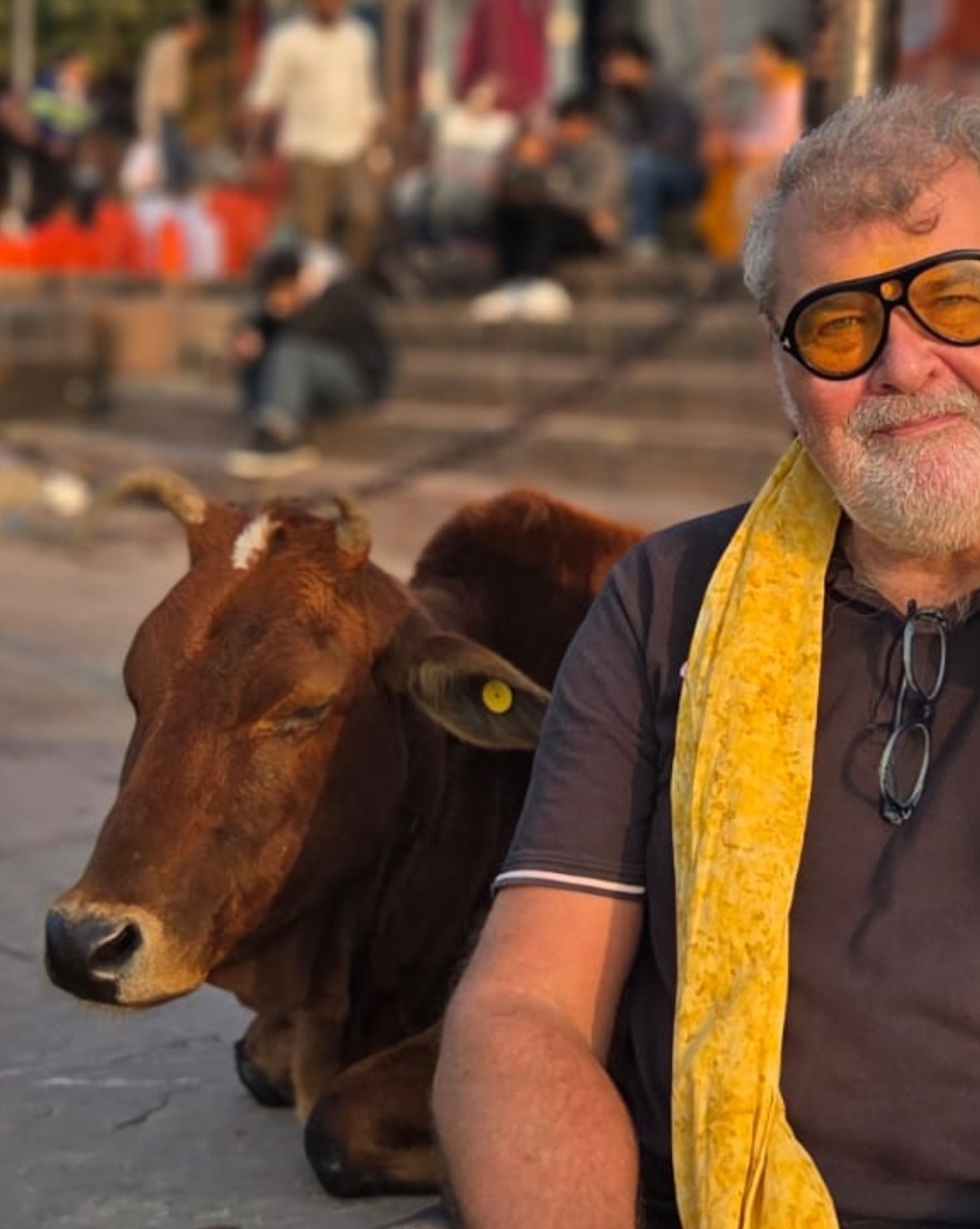
The cows and bulls sprawled on the sandbanks and stone steps along the river share in this holiness. To injure a cow, or worse, to kill one, is a mortal sin. And so, they take their place in the world with dignified calm and the assuredness of their sacred status: halting traffic on busy highways when two cows decide to lie down on the warm tar; wandering unperturbed through markets, nibbling at piles of sweet potatoes, mangoes, and red Indian carrots.
A cow heavy with calf stretches out on her side, eyes closed in bliss, while a stallholder scrubs her hide with a broom dipped in soapy water. Two little girls in yellow saris scramble up onto the solid hump of a reclining grey Brahman bull, who gazes dreamily toward the river. One child walks straight across his neck, giggling, and the bull answers with a gentle, accommodating rumble.
When the evening prayers along the Ganges are finished and the marigolds have blessed the water, every bovine in the vicinity turns up in search of a final mouthful of flowers to end the day. Bulls and cows move calmly through the crowds who have gathered to watch the ceremony.
Some pluck blossoms from the still water; others settle among the worshippers and a scattering of tourists. Their hooves click on the stone, and the animals sigh with pleasure and contentment, as if they know themselves to be part of the occasion.
A brown-and-white cow with short, curling horns comes to a halt beside me, her head level with my chest. The farmer in me takes over: I reach out and give her a proper, hearty scratch between the horns. She yawns. A long, thick, pale-pink tongue lolls from her mouth. Beside us, the sinking sun paints the river gold and rose.
Two barefoot boys step up in front of the cow, each holding a tin bowl. I do not want to spoil the moment, but I have no alms with which to tinkle their cups. I shake my head. The boys are untroubled. They crouch, slip beneath the cow, and I hear the warm frothy sound as jets of milk strike the metal bowls.
Enjoyed this article?
Subscribe and never miss a post again.
Jinne, jy skryf só mooi! Dankie dat jy ons saam op reis en avontuur neem.
Jy is die penmeester en storieverteller, van formaat verby.
Mag jou ink nooit opdroog nie.
Dankie.
Dankie Meneer! Soveel om te seg oor daardie land. groete
Your descriptions are tactile and grounded. The Ganges is not abstractly “sacred” but bodily: “ice-blue, grey skin,” a force “pressing beneath” the surface. That physicality carries through to the cows themselves, whose sanctity is expressed not through reverence alone but through intimacy—children climbing a bull, a stallholder washing a cow, the narrator scratching between horns. The sacred and the ordinary are inseparable.
The final image is particularly strong. After all the ritual and beauty, the story closes not with transcendence but with milk hitting tin bowls—warm, frothy, practical. It’s a perfect ending: life continuing, sustenance drawn directly from the sacred without ceremony or apology. That moment reframes everything that comes before it and gives the piece its quiet power. Well done…you transported me to that place and I enjoyed the space with you!
Thanks for the comment Zalda. It was a magical experience.
Of course, I relished every word in the body of the article and , indeed, also the framing of your words in your commentary Zalda Hughes. Both considered observations. Thank you.
The article is like a description of a picture taken during late afternoon. I was hoping for anything that has to do with wine…. but none…. especially in India….